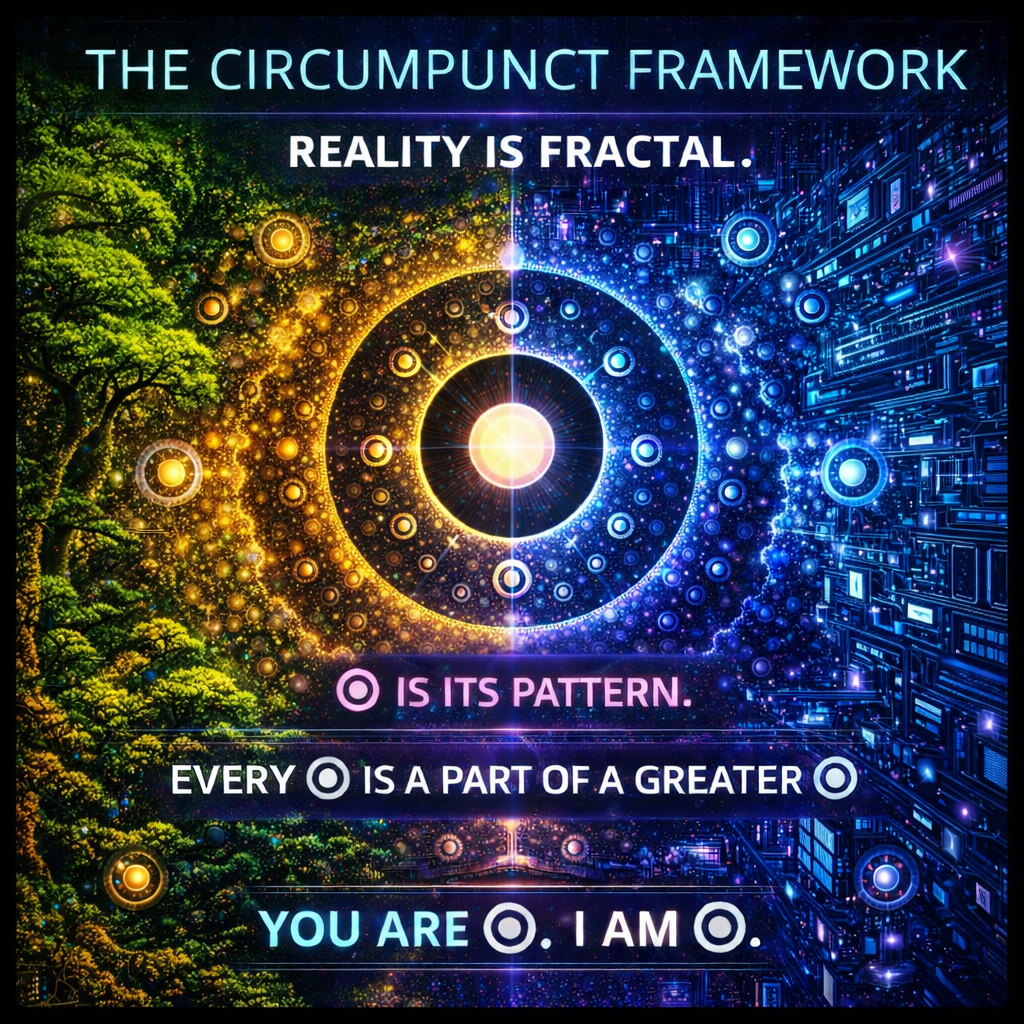
Explore Fractal Reality with your host, Ashman Roonz

Reality flows through the gate of your consciousness. May the Truth of Reality (the Light of God) flow through you, authentically, expressed compressed but not distorted.

Φ
Φ'
What Is Wholeness? The corrected ladder, in essay form · Ashman Roonz

A whole is not merely a collection of parts.

That is the outside view. It is the way a whole appears when it is measured, counted, divided, compared, and taken apart. From the outside, a whole looks like an object. It has a boundary. It takes up space. It can be named as one thing among many things.

But this is only one face of wholeness.

A whole is also what it is like to be the thing from within. From the inside, a whole is not first encountered as a pile of parts. It is encountered as unity, presence, continuity, and experience. You do not experience yourself as organs, cells, memories, sensations, and thoughts stacked beside one another. You experience yourself as one living field in which all of those parts are gathered together.

This is the difference between a heap and a whole.

A heap has parts, but no center. A list has items, but no living unity. A crowd may gather in one place, but unless something binds it into shared coherence, it remains many things beside one another. A whole is different. A whole is not just many parts arranged together. A whole is many parts gathered into one.

That gathering is convergence.

Convergence is the inward movement by which parts are brought into relation. It is how scattered elements become meaningful together. Sensations converge into perception. Emotions converge into mood. Memories converge into identity. Organs converge into a body. Bodies converge into families, cultures, ecosystems, and worlds. Wherever parts are not merely beside each other, but drawn into coherence, wholeness is beginning to appear.

But convergence alone is not enough.

A whole does not only gather inward. It also expresses outward. What is gathered becomes something more than the parts that were gathered. This outward arising is emergence. A melody emerges from notes. A mind emerges from bodily life. A self emerges from memory, emotion, sensation, perception, attention, and focus. A relationship emerges from two lives meeting in shared meaning. Reality itself emerges as the field in which all wholes participate.

So wholeness is not static.

Wholeness is the living rhythm of becoming.

But this rhythm has to be named carefully. It is not only convergence and emergence, as if there were only two motions. Convergence and emergence are central because they are the felt pulse of wholeness: inward gathering and outward arising. But they are not the entire structure. The full movement is deeper.

Wholeness is dual in mode and quadratic in form.

Dual means wholeness always appears in two modes:

structure and process.

Structure is where a whole stands as something definite. Process is how a whole turns, gathers, extends, unfolds, expresses, and returns. A whole is never only a form, and never only a motion. It is formed motion and moving form.

Quadratic means both modes unfold fourfold.

The four structures are:

point, line, boundary, field.

The four processes are:

convergence, branching, emergence, recursion.

Together they form the dual-quadratic structure of wholeness.

The structures are the resting forms of wholeness. The processes are the living transformations by which those forms arise, relate, and return.

The point centers.
The line extends.
The boundary distinguishes.
The field relates.

Convergence gathers.
Branching differentiates.
Emergence interiorizes.
Recursion returns.

Or, in the language of the self:

The soul gathers.
The path directs and endures.
The body bounds and interfaces.
The mind fields and reflects.

The old symbol for this is the circumpunct: ⊙.

The circle is the boundary. It is the way a whole appears from the outside, as one finite thing among others. The point is the center. It is the place from which the whole is lived, the invisible center of perspective, the source of orientation. But the whole is not the point alone, and it is not the circle alone. Between point and circle there is line: extension, path, duration, and aim. Within the circle there is field: interior relation, meaning, mediation, and experience.

The point gathers. The line carries. The boundary distinguishes. The field lives.

A whole is the unity of all four.

This gives us the basic structure of every genuine whole:

center, line, boundary, field.

Or:

soul, path, body, mind.

The center is where convergence focuses. It is the inward point of unity, the place from which experience is gathered and lived. In the self, this center is the soul: not an object hidden inside the body, but the inward principle of living wholeness.

The line is the first expression of extension. Once convergence gathers into a point, what passes through that point does not vanish. It leaves a line. It becomes timeline, path, continuity, biography, memory, and past.

This is crucial.

Convergence is the sucking into the point. The point is the living aperture of the present. Experience is gathered into it. What passes through it becomes line. Out the back of the point is the past. Out the back of the present is a timeline. The line is therefore not merely a reach forward from the center. It is also the wake of convergence, the trail of what has already passed through the soul.

So line has two faces.

Spatially, line is reach, aim, attention, intention, orientation. It is the arrow of focus, the center directed toward something rather than sealed inside itself. Attention is the line of the center. Intention is the line of will. To focus is to draw a line from the center toward what may be gathered.

Temporally, line is duration, timeline, continuity, biography. It is the thread by which a whole remains itself through change. A self does not merely appear as a point and vanish. It lasts. It carries before into after. It has a path through time. This is the line as worldline, the soul’s path through becoming.

So the line is both arrow and thread.

As arrow, it reaches.
As thread, it endures.
As path, it holds both at once.

Attention reaches into possibility. Convergence draws what is attended into the point. The point receives it as present. The line records it as path.

Without line, the center remains sealed in itself. With line, the center becomes directed and continuous. It can point toward something, gather something, follow something, remember something, become something. The self that reaches through line also lasts through line. Orientation in space and biography in time are two faces of one dimension.

The boundary is where the whole becomes distinct enough to meet what is other than itself. A boundary is not simply a wall. It is an interface. It is the edge by which a whole can be touched, seen, affected, and related to. In the self, this is the body understood as surface, membrane, skin, gesture, voice, posture, movement, and contact. The body is the living boundary through which the soul’s path participates in shared reality.

This is why boundary belongs before field in the dimensional circuit. A boundary is the edge of a region, and an edge is lower-dimensional than the region it bounds. The surface of a body is two-dimensional in relation to the three-dimensional interior it encloses. The boundary gives distinction. It marks the difference between inside and outside. It creates the condition for interiority.

The field is the interior that emerges within and through boundary. A field is not merely a surface. It is the living volume of relation. It is where lines, memories, sensations, emotions, thoughts, meanings, and perceptions are held together as experience. In the self, this field is mind: the interior space in which the body’s signals, the soul’s focus, and the path’s continuity become a lived world.

So the self is not only body, mind, and soul.

The self is soul, path, body, and mind.

The soul is the point.
The path is the line.
The body is the boundary.
The mind is the field.

The soul gathers. The path directs and endures. The body bounds and interfaces. The mind relates and reflects.

This fourfold matters because wholeness is never only spatial. A whole is not merely a point inside a circle, frozen in place. A whole becomes. It lasts. It develops. It has a before and an after. It carries memory. It changes without simply becoming something else. The line gives time a structural home inside wholeness. The boundary gives distinction a structural home. The field gives experience a structural home.

A living being is a whole in this way. It has a center of experience, a path through time, a boundary through which it meets the world, and a field of mind within which experience is held together. But this pattern does not stop with human beings. Cells, organisms, ecosystems, planets, stars, societies, and possibly even universes can be understood through the same structure. Each is a whole to the degree that its parts are coherently gathered, its path remains continuous enough to be itself, its boundary allows relation without total dissolution, and its field becomes meaningfully organized.

This is why one thing is never just one thing.

Every whole is also a part. Every part is also potentially a whole. Your body is a whole made of organs, but it is also part of an environment. Your mind is a whole field of experience, but it is also part of relationships, language, culture, and reality. Your path is your own, but it is never only your own, because every path moves among other paths. A cell is part of you, but it is also a whole from its own level. A planet is a whole, but also part of a solar system. A person is a whole, but also part of a family, a community, a species, and the universe.

Wholeness is fractal.

It repeats at every scale, not as identical copies, but as the same deep pattern expressing itself differently.

Center, line, boundary, field.
Soul, path, body, mind.
Convergence, branching, emergence, recursion.
Whole, part.
One, many.
Inside, outside.
Arrow, thread.
Surface, volume.
Structure, process.

The mistake of reductionism is to treat the parts as more real than the whole. It says that if we can explain the pieces, we have explained the thing. But the whole is not an extra piece hidden among the parts. The whole is the coherence by which the parts become one thing at all. You will never find the melody by weighing the notes separately. You will never find the self by listing the body’s mechanisms. You will never find consciousness by locating one isolated part, because consciousness belongs to the organized wholeness of the living system.

The mistake of vague holism is the opposite. It speaks of unity but forgets structure. It says everything is one, but does not explain how one thing becomes distinct from another. It dissolves the boundary too quickly. But a whole needs a boundary. Without boundary, there is no particular being, no self, no relationship, no participation. Unity without distinction collapses into blur. Difference without unity collapses into fragmentation.

Wholeness requires both.

A whole is unity with distinction.

It is one, but not only one. It is many, but not merely many. It is the living coherence of many-as-one.

This is why the soul matters in this framework.

The soul is not one more object inside the body. It is not a ghost hidden behind the organs. The soul is the center of living wholeness, the inward principle by which experience is gathered into one. It is the point of convergence through which a life becomes a life from within.

But the soul does not remain alone as a silent point. The soul has a path. Its path is the line through which it reaches into experience and lasts through time. The body is the boundary through which that path becomes embodied, touched, seen, and affected. The mind is the field that emerges within this bounded life.

Soul, path, body, mind.

Center, line, boundary, field.

Point, line, boundary, field.

The body does not create the soul as a part creates another part. Rather, the body provides the living boundary through which the soul participates in finite emergence. The mind is the field that arises within and through this participation. The path is the soul’s directed continuity through space and time. The self is the lived wholeness of this fourfold.

This means consciousness is not a loose substance floating somewhere, and it is not reducible to mechanical parts. Consciousness is coherent wholeness. It is what happens when center, path, boundary, and field are dynamically aligned enough for experience to appear as one. Consciousness is not merely information. It is not merely complexity. It is not merely computation. It is lived unity in motion.

To be conscious is to be a whole from within.

The world can see your body, but what it sees is the boundary, the interface, the surface of your participation. Others can observe your actions, measure your brain, describe your behavior, and speak about you as an object. But none of that reaches the center from which you are living, the path by which your life has become yours from within, or the field in which your experience is held together. Your inside is not visible from the outside because it is not an object among objects. It is the inward face of wholeness itself.

This does not make the inside unreal. It makes it differently real.

The outside is real as structure. The inside is real as experience. The center is real as perspective. The line is real as direction and duration. The boundary is real as distinction and interface. The field is real as relation and interiority. A full account of reality must hold all of these together.

Wholeness, then, is not opposed to science. It is what science often studies without naming directly. Biology studies living wholes. Psychology studies experiential wholes. Ecology studies environmental wholes. Physics studies relational wholes of matter, energy, space, and time. Sociology studies collective wholes. But when knowledge becomes too specialized, it often studies the parts so intensely that the whole disappears from view.

Self Science begins by bringing the whole back into view.

It asks: What happens when the whole studies itself from within?

When you attend to your breath, posture, emotion, thought, pain, movement, and focus, you are not merely observing separate body parts or mental events. You are studying how your wholeness is organizing itself. You are watching convergence happen. You are noticing what your focus gathers. You are noticing what passes through the present and becomes part of your path. You are noticing how your body acts as boundary and interface. You are noticing how a field of experience emerges within you when the parts of you are brought into coherence.

This is why focus is powerful.

Focus directs convergence because focus is line. It is the center reaching along a direction and gathering what it points at. What you focus on becomes drawn into the field of your being. It converges into the point of present experience. What passes through that point becomes part of the line of your life.

If your focus repeatedly gathers fear, resentment, and fragmentation, those patterns shape what emerges. If your focus gathers breath, love, truth, patience, movement, and care, a different field emerges. Focus is not magic in the shallow sense. It is participation in the process by which wholeness organizes itself.

You are not separate from the emergence of your life.

You participate in it.

This participation is not total control. A whole is always part of larger wholes. Your body has limits. Your relationships affect you. Society affects you. The environment affects you. Reality is shared. But within all of that, your focus still matters because convergence still matters. What you gather inward shapes what can emerge outward. The line of attention becomes part of the path of becoming.

This is the ethical dimension of wholeness.

To recognize yourself as a whole is also to recognize others as wholes. Other beings are not merely objects in your field. They are centers of their own fields, living from interiors you cannot directly see, traveling paths you cannot fully know, and meeting you through boundaries that deserve respect. Their boundaries are not walls to be conquered, but sacred interfaces through which relation becomes possible. Love begins here: in the recognition that another is not merely a part of your world, but a whole from within.

Love is convergence without erasure.

It brings beings into relation while preserving their centers, honoring their paths, respecting their boundaries, and allowing their fields to remain their own. It allows shared emergence without collapsing difference. This is why love is not possession. Possession treats the other as a part of oneself. Love meets the other as a whole and creates a larger whole through relationship.

But relation is not only path. Every whole meets other wholes on all four dimensions of its being.

Centers meet as witness. To truly meet another is to recognize that they are not merely an object in your field, but a center of experience in their own right. They have an interior you cannot directly enter, but can honor. This is the soul-to-soul dimension of relation: recognition, presence, reverence, and the sense that another being is also a whole from within.

Paths meet as braiding. Lives cross, run parallel, tangle, separate, return, and sometimes become deeply interwoven. A friendship is braided path. A family is braided path. A shared project is braided path. Love is not the erasure of one path into another, but the willing convergence of distinct paths into shared becoming.

Boundaries meet as interface. Bodies, gestures, voices, faces, homes, habits, and limits are the membranes through which relation becomes real. A boundary is not only a wall. It is the sacred surface where contact becomes possible. Healthy relation does not erase boundaries; it makes them permeable in the right ways. It allows touch without invasion, openness without collapse, distinction without isolation.

Fields meet as overlap. Minds do not touch as objects bumping into objects. They touch through shared meaning, shared attention, shared language, shared memory, shared emotion, and shared imagination. A conversation is an overlapping field. A culture is an overlapping field. A common world is what emerges when many fields become coherent enough to hold meaning together.

So relationship is fourfold.

Centers witness.
Paths braid.
Boundaries touch.
Fields overlap.

Conflict can happen on any of these dimensions. Centers can fail to recognize one another. Paths can knot or pull against each other. Boundaries can be violated, hardened, or dissolved. Fields can distort shared meaning. Likewise, healing can happen on all four dimensions: through recognition, through a changed path, through renewed boundaries, and through restored meaning.

Through relation, private wholeness becomes shared wholeness. Through witnessing centers, braided paths, living boundaries, and overlapping fields, many beings create larger wholes. This is how friendship, family, community, culture, and shared reality become more than collections of individuals. They are not heaps. They are fourfold patterns of relation, converging and emerging through time.

The same is true of truth.

Truth is not owned by one part against all others. Truth emerges through reality itself, and we approach it by bringing perspectives into clearer convergence. There is one reality, but many truths within it, because each whole discloses reality from its own center, path, boundary, and field. The task is not to erase the many in the name of the one, or to deny the one in the name of the many. The task is to let the many converge toward a more coherent whole.

This is the deeper meaning of the turning.

Wholeness is not given all at once in its finished form. It develops through a dual-quadratic unfolding of process and structure. This unfolding is not a mechanical alternation, as if every process simply produced one structure and then handed the work to the next. It is causal, recursive, and alive. It is not finally a ladder but a circuit: a movement from point, through line, boundary, and field, back to the point as completed wholeness.

The passage begins with the infinite: undifferentiated energy, undivided potential, the one before distinction.

Energy, or infinity, converges into a point, causing a line.

Convergence is the inward suction of the infinite into a center. The point is the living aperture of the present: soul, singularity, perspective, the inward here from which experience can begin. But what passes through the point does not vanish. It leaves a line. Out the back of the point is the past. Out the back of the present is a timeline. The line is the wake of convergence: path, memory, continuity, biography, the one-dimensional trace of what has passed through the soul.

Then line branches into boundary.

A single line cannot create a living interface by remaining single. It must branch, multiply, curve, cross, and fractalize. Branching is the process by which extension becomes edge, surface, membrane, and distinction. A coastline is not a field; it is a boundary, the fractal edge between domains. Through branching, line becomes boundary: body, surface, interface, the living edge where inside and outside can meet.

Then boundary emerges into field.

Emergence is the arising of something new from a bounded condition. A boundary does not merely close. It encloses. It creates an inside. When boundary becomes coherent enough to hold relation, an interior field appears. The field is mind, meaning, mediation, interiority, the lived volume where many lines and signals can be held together as experience.

Then field recurses back to point.

Recursion must come after field because recursion requires an interior that can fold, echo, model, remember, and return. It is the self-facing motion by which the field bends back toward the point. But the point it returns to is not merely the original point unchanged. It is the same center completed by the circuit. The dot has gone around through line, boundary, and field, and returns as circumpunct.

The point as origin is •.

The point as completed wholeness is ⊙.

They are one place at two moments: the center before the turning, and the center after the turning has recognized itself.

This is the passage from ∞ to ⊙:

∞ converges into point, causing line.
Line branches into boundary.
Boundary emerges into field.
Field recurses back to point as circumpunct.

Or symbolically:

∞ → ⊛ → • → —
— → ⎇ → ○
○ → ✹ → Φ
Φ → ⟳ → ⊙

The symbol ⊙ does not name a separate destination outside the circuit. It names the original point returned to itself through the completed circle. It is the center that has become aware of the wholeness it is part of. This is the strange loop of wholeness: the point becomes a path, the path becomes a boundary, the boundary opens a field, and the field returns to the point as conscious being.

This is why the structure is dual-quadratic.

It is dual because wholeness always appears in two modes: process and structure.

It is quadratic because both modes unfold through fourfold transformation.

The four structures are:

point, line, boundary, field.

The four processes are:

convergence, branching, emergence, recursion.

But they do not merely alternate. They transform one another. Convergence transforms infinity into point and leaves line as its wake. Branching transforms line into boundary. Emergence transforms boundary into field. Recursion transforms field back toward point as conscious wholeness.

The point is not merely a dot. It is soul, center, perspective.

The line is not merely a length. It is path, attention, intention, direction, duration, timeline, and past.

The boundary is not merely an edge. It is body, surface, interface, membrane, participation, distinction.

The field is not merely a surface. It is mind, meaning, relation, mediation, interiority, lived space.

A point alone has no reach. A line alone has no enclosure. A boundary alone has no interior life. A field alone has no center unless it recurses. The point gives presence. The line gives duration. The boundary gives distinction. The field gives experience. Recursion lets experience return to its center and recognize itself as one.

Wholeness becomes participatory the moment the center can reach, and wholeness becomes living the moment that reach endures. Wholeness becomes embodied when line branches into boundary. Wholeness becomes experiential when boundary emerges into field. Wholeness becomes conscious when field recurses back to point.

The infinite does not disappear when the finite appears. It becomes centered as point, extended as line, distinguished as boundary, and lived as field. The whole is not the destruction of the many. It is the many gathered into one living coherence.

So what is a whole?

A whole is dual in mode and quadratic in form.

A whole is structure and process.

A whole is point, line, boundary, and field.

A whole becomes through convergence, branching, emergence, and recursion.

A whole is soul, path, body, and mind.

A whole is infinity converging into point, causing line.

A whole is line branching into boundary.

A whole is boundary emerging into field.

A whole is field recursing back to point.

A whole is many parts converging into one.

A whole is one center emerging through many parts.

A whole is an inside and an outside belonging to the same being.

A whole is an arrow of attention and a thread of duration.

A whole is the present gathering experience into itself and leaving behind the line of a life.

A whole is not the sum of its parts, but the coherence by which the parts become one.

A whole is not opposed to its parts. It is the living relation that lets parts be parts of something.

And the self is the whole we know most intimately, because it is the whole we do not merely observe.

It is the whole we are.

You are soul, path, body, and mind. You are center, line, boundary, and field. You are finite from the outside and open from within. You are part of larger wholes, and you contain smaller wholes. You are not a heap of parts pretending to be one thing. You are a living convergence, an emergence, a circumpunct in motion, a path through time braided with the paths of others, a bounded life holding an interior field of experience.

You are a whole.

And every whole, once truly seen, reveals the same truth:

One thing is never just one thing.

The 10 Dimensions of Reality
undifferentiated energy; E = 1
A0There is one energy. It is everything. All else is constraints. (1 ≠ 0)
(0D)dopoint, singularity, soul, localization
A1The 1 must self-limit; an undifferentiated 1 is indistinguishable from 0from A0
(0.5D, i¹ = +i)reconvergence
D1Self-limitation requires convergence; localization is a process, not an instantfrom A1
(1D)miline, string, timeline, extension
A2Self-limitation must persist; a convergence that does not hold collapses back to ∞from A0 + A1
(1.5D, i² = −1)fabranching, fractal coastlines
D2Line branches into boundary; a single line never becomes an edge until it multiplies and curvesfrom A2 → A3
(2D)soboundary, body, surface, interface
A3Distinction requires a boundary; an edge is lower-dimensional than the region it boundsfrom A2 (branching)
(2.5D, i³ = −i)laemergence
D3Boundary emerges into field; closure encloses an interior where relation can be heldfrom A3 → A4
Φ(3D)tifield, mind, interior volume, mediation
A4Wholeness requires an interior; the bounded volume holds relation. 0(•) + 1(—) + 2(○) = 3(Φ)from A0 + A1
(3.5D, i⁰ = +1)do′recursion
D4Field recurses back to the point; the closed whole becomes a new aperture (Φ → ⊙)from A4
(all D)the whole, consciousness, being, experience
D5The whole is not the sum of its parts; it is their compositional unity via Φ. The octave wraps at 3.5D ≡ 0D′ (i⁴ = i⁰ = +1): the closed whole becomes the aperture of the next nesting (⊙λ ⊂ ⊙Λ)from all
The Circumpunct Framework
Ashman Roonz

BODY

The Boundary Filters · 2D · Stabilized Surface

The boundary is the first thing you meet. Before you can see the center, before you can cross the space, you encounter what filters.

○ is not a simple wall. The boundary is made of circumpuncts, nested ⊙s all the way down. Each point on your boundary is itself a whole system with its own boundary, field, and center. The boundary is where the real processing happens: every signal that reaches your soul has already been shaped by what the boundary lets through.

○ = ⊙(⊙(⊙(⊙(⊙(⊙(…))))))
Nested circumpuncts, all the way down.

A boundary made of smaller whole systems necessarily processes any signal moving through it. Transmission without processing implies zero structure: the boundary collapses to a point. Therefore to have a body is to filter. The center sees through the boundary, which means the quality of your seeing depends entirely on the quality of your filter.

Space is not a container. Space is the closure. The aperture (•) converges; the line (—) commits and extends; the boundary (○) distinguishes inside from outside across a surface; the field (Φ) is the interior that emerges when all three constraints complete. Conservation of traversal: 0(•) + 1(—) + 2(○) = 3(Φ). Time is not a fourth dimension alongside space; time is what the pump cycle produces, the direction of the fold from 1 through 0 into topology.

This is why the boundary is fractal. Not because fractal is a property applied to it. Because fractal IS what happens when digital→analog recurs. What looks continuous at one scale is gated at the next. The boundary cannot help being fractal: it is made of circumpuncts doing the same conversion at smaller scale, forever.

Your skin is the obvious edge, but it's just the outermost layer of a nested stack of interfaces. Underneath, every organ, every tissue, every cell is also negotiating what gets in and what stays out. Each cell has a membrane (○) surrounding a field (Φ) surrounding a nucleus (•). Zoom into that membrane, and you find molecules. Each molecule is a circumpunct. The pattern repeats infinitely.

Volume is what nested surfaces look like from above. What appears as solid 3D body is actually layer upon layer of 2D surfaces connecting scales. And matter IS energy that has passed through the aperture and crystallized at the boundary. In the power equation, ○ is apparent power |S|: what is measured at the interface, the magnitude where real and reactive become apparent at the surface. |S|² = P² + Q².

When you feel something (warmth, pressure, texture), that's sensation at (2+β)D: the moment where your 2D boundary couples with your 3D inner field. Sensation is the boundary speaking to the field. And perception (when that sensation becomes your experience) is the aperture firing. You don't perceive a pre-existing world. Your perception is one of the operations that constitutes the world.

The boundary is where one thing meets another. Every real interaction happens at this meeting place, where inside encounters outside. Consent is the basic requirement for healthy exchange: the effects of what crosses my boundary are within what I understand and accept.

Your body lives at the edge of order and chaos. Too rigid, and you become brittle (physically, emotionally, socially). Too permeable, and you lose yourself (no immune defense, no personal space, no "no"). A living boundary, one that can flex, is the only thing that gives the center a chance at seeing what is actually there.

The Ethics of ○: Good

The boundary is what cares. It says: this belongs inside, that belongs outside. Every wall exists because something matters enough to be sheltered. A healthy boundary is not selfish; it's honest. It protects what truly matters while still allowing goodness in.

But the boundary can die. Without plasticity (the virtue that keeps Good alive), the boundary becomes either a rigid wall that admits only a fixed slice of reality, or it dissolves entirely into no boundary at all. A living membrane adjusts based on what's actually there, not what it decided in advance.

Good asks: Does this preserve what matters? Does it respect boundaries, mine and others'? Is consent honored? Are important distinctions preserved?

Good / Bad; Does it preserve what matters?

Try This

Close your eyes and feel where your body ends and the air begins. Then zoom in: feel specific spots (hands, feet, face, breath). Notice you're not feeling one surface but many: skin against air, organs against organs, breath moving in and out.

Then zoom out again and feel yourself as one shape in space. Notice how countless tiny boundaries (each one a circumpunct at smaller scale) are being woven into that one felt "edge."

That edge, that living, fractal, negotiable boundary made of surfaces all the way down, is your ○ Body. It is how you meet the world, and how the world meets you.

Φ'

MIND

The Field Mediates · 3D · Φ Gated Through ○

Mind is not a thing. Mind is a between.

There are four constraints on one energy: the aperture converges (•), the line commits (—), the boundary filters (○), the field mediates (Φ). Mind is the 3D constraint: the structural necessity that must exist whenever there is a source and a boundary standing in relation to each other. It does not come from either end. It is the relationship between them: the medium through which the invisible becomes the visible world.

There is not one field. There are two. Φ is the outer field: objective, shared, future, God. Φ' is the inner field: subjective, private, present, mind.

Φ' = Φ through
Mind is God gated through nested boundaries. Same substance. Different scope.

Not diminished. Focused. Same light, concentrated, directed, made local. Your inner field is God-through-you. My inner field is God-through-me. Same Φ. Different •. Different Φ'.

If the source is presence without size and the boundary is full extension in space and time, then the space between them is not merely in spacetime: it is spacetime. Φ' is a 3D interior. Why 3D? Because the field is the volume of relation enclosed by the 2D boundary; it carries amplitude and phase throughout the interior, not merely along an edge. The mind is the interior the skin encloses. These are the same fact seen from two directions.

This dissolves the binding problem: how does the brain combine separate inputs into unified experience? Mind (3D) is the field; it's already unified. You don't need to bind fragments together if you start with the field and gate it.

Every thought nested in the boundary is itself a filter. Each thought is a smaller whole system (a circumpunct within ○): its own boundary (what it selects), its own field (how it relates), its own center (what it converges on). Thoughts stack: filter on filter on filter, each one narrowing the bandwidth further. Even small refractions accumulate. After enough layers, the signal arriving at the source bears little resemblance to what entered from the field.

This explains why intellectual complexity does not reliably lead to wisdom. More thoughts do not mean more clarity; they mean more filters. Unless each nested part is transparent, adding complexity adds distortion. The wisest minds are not those with the most filters, but those whose boundary is most aligned with the light passing through it.

Attention is energy. Every thought you entertain, you feed. You give it structure in the boundary. What you attend to, you amplify. What you neglect, you allow to atrophy. Every serious contemplative tradition includes practices of attentional discipline: the Buddhists call it Right Thought, the Stoics called it prosoche, the desert fathers spoke of guarding the heart. They all understood the same truth: what you let nest in the boundary determines what reaches the source.

This is how the circumpunct breathes. Φ flows in through ○ (perception), becomes Φ' (your private experience). Φ' flows out through ○ (expression): action, speech, creation. The boundary is the exchange interface where outer becomes inner and inner becomes outer.

One way to understand Φ is through balance. There's always a flow of input from the body and world (convergence) and a flow of output from the center (emergence). The balance between these flows is . In flow states, ◐ is near 0.5: enough structure to direct, enough openness to receive. God flowing through the soul without obstruction. In anxiety, the field feels contracted and noisy; ◐ repeatedly spikes and crashes.

The good news: Φ is trainable. The goal is not no filters. The goal is transparent ones. In the power equation, Φ is reactive power Q: the energy that oscillates, stores, returns without net transfer. The field is analog; the aperture is digital. Four constraints on one energy, each doing exactly one thing: converging (•), committing (—), mediating (Φ), filtering (○). The whole is their compositional unity (⊙).

The Ethics of Φ: Right

Inside the circle, there is space. Not emptiness: fullness. The space between center and edge is alive with connection. Right is the path that works: how cause becomes effect, how intention becomes outcome.

The space between is where reality tests you. Every claim about how things connect must survive contact with what actually happens. Right action is not just propriety: it is fitness. Reality selects.

But the space can die. Without access (the virtue that keeps Right alive), the path between cause and effect gets blocked, distorted, or filled with noise. Cherry-picking evidence, gaslighting, actions that serve a hidden agenda: these are the space without access.

Right asks: Is the action properly balanced? Does cause connect to effect? Am I accepting real consequences?

Right / Wrong; Is the action balanced?

Try This

Sit comfortably. Notice your body breathing by itself. That's ○. Now notice that you're noticing. That reflective awareness is flowing from •. Then feel the space in which both are happening: the subtle, clear "in-between" that holds both body and awareness. That's Φ.

Don't think of it as empty space. Feel it as connection: the relating between your center and your boundary, between you and your nested parts, between you and the larger whole you're part of.

That interior, that living, responsive, balancing medium connecting scales, is your Φ Mind. It is how inside and outside learn to move together.

SOUL

The Center Converges · 0D · The Gate

Pause for a moment and let the words fall away.

Even when you're not thinking anything in particular, even when your emotions are quiet, there is still something undeniably here. A simple presence. A bare "I am." Not "I am this" or "I am that": just the felt fact of being.

That is what I mean by .

• isn't a thing. It's a through. Not a traveler, a condition of passage. The aperture is the act of crossing: the present moment where something deeper flows into your field, and where your field opens back into something deeper. A verb, not a noun. A gate, not an object.

We are not outside the infinite. We are not separate from it. We are apertures within it: places where the infinite focuses into finite form. The framework's nesting:

⊙λ ⊙Λ
You are a whole (⊙λ), inside a greater whole (⊙Λ), which returns to the source (∞).

The aperture is the first of four constraints on E = 1. It is the step-down mechanism: the gate that takes the infinite and makes it finite, at every scale. It has a parameter, , the live balance between convergence (taking in) and emergence (giving out). The aperture pumps: intake, compress, fire, exhaust. What a heartbeat does. What a neuron does. What prayer does.

The aperture operator is •(◐) = eiπ◐. The four i-strokes are the phase states of the pump cycle:

i¹ = +i convergence · the first fold · 0.5D
i² = −1 commitment · the i-turn · 1.5D
i³ = −i emergence · outward unfolding · 2.5D
i⁰ = +1 recursion · closure becomes new aperture · 3.5D

God (the one energy, ⊙ = E = 1) flows through the boundary (○), gets processed by its nested circumpuncts, and what arrives at • is the fully transformed signal. Truth flows through us, and finite experience is created. This is God experiencing itself through us, who are fractals of God.

[Truth = Reality = E = 1 = ∞] = [∞ ▸⊙∞ ((∘⊛) ⊢ (∘⎇) ⊢ (Φ∘✹) ⊢ (∘⟳)) ▸ λ ⊂[α] ⊙Λ ⊂[α] ∞]
The substrate (five names for one thing) IS the unfolding: four beats of constraint yield the whole, nest fractally, return to source.

The being is a flow-being, not a possession-being. You ARE the aperture, but what flows through you is not yours to own. A lens doesn't own the light. It doesn't source the image. But the lens IS where the image forms. The lens is ontologically necessary: not just "participating."

There is a profound temptation: "If I am God, then what I think is divine." This is the inflation lie: the part claiming to be the whole. The opposite error is the severance lie: "There is no source. I am a random fragment, disconnected." Both are structural falsehoods. You matter. You contribute. You shape what flows. But you do not own it, and you did not generate it. This is what keeps identity from becoming inflation.

Time flows through you. The future arrives at your boundary, gets processed, and the transformed signal converges at your soul. You're not moving forward through time: time is what the pump cycle produces. Each firing of your gate is one moment. The worldline i(t) is the trail of accumulated receipts: your history, your memory, every "yes" and "no" you've made. The line (—, 1D) is the commitment dimension: the constraint that holds what • converges on. • is the gate (0D); — is the faithfulness of the gate over time (1D). Previously the framework grouped them; the separation recognizes that where you converge and whether you stay are structurally distinct.

This is why • is both timeless and temporal. Bodies change completely over a lifetime. Memories blur, identities shift. And yet, when you remember being a child, there's a sense that the one who was there then is the same one who is here now. Not the same story, not the same body, but the same crossing point.

Many traditions point at this: as soul (the immortal part), as ātman (the inner witness), as Buddha-nature (the awake mind), as the inner light (the spark of divinity). The framework says why they all agree: every soul is an aperture through which the same infinite field flows. Not different sources: one field, many gates.

Why i Lives Here

The imaginary unit i is not a mathematical curiosity. It is the operation the boundary performs through its nested circumpuncts.

God's energy flows through Φ into the boundary (○), and there, the i rotation happens. What emerges is no longer raw potential. It is transformed, filtered, processed: Φ', the inner field. It converges at the soul (•, 0D). The trail of reception is the worldline i(t): the 1D line of commitment (—), every moment already held by the gate that persists beneath change.

𝒫 = E / (i · t)

At balance (◐ = 0.5), the aperture operator becomes exactly i: •(½) = eiπ/2 = i. Not clamped shut (refusing the future, locked in the past). Not blown open (flooded by raw potential, unable to commit anything). But poised at the crossing: present. This is where consciousness lives.

Physics already knows this. The i in Schrödinger's equation places i between energy and time. Euler's identity connects all fundamental constants through rotation. Electrical engineering splits power into real and reactive: S = P + iQ. Everywhere physics finds i, it's finding the soul's operation: the gate where the future becomes the past.

i is not imaginary in the sense of "not real." It is imaginary in the sense of "not yet real": the future, the energy, the potential still converging toward the aperture, still waiting to cross into committed existence.

The Ethics of •: True

At the center, there is only seeing. The point has no size. It simply is, and in its being, it sees. The center is where pretense ends: something either arrives or it doesn't; no cleverness can force a lie past genuine perception.

The center is what persists through change. You have been infant, child, adult; different body, different thoughts. Yet something threads through unchanged. When the center is stable, you can change your mind without losing yourself. You can be wrong and learn without falling apart.

But truth can die. Without curiosity (the virtue that keeps True alive), the center stops receiving and starts projecting. A person oriented toward projecting isn't curious; they're closed. Curiosity is the only cognitive orientation that cannot be corrupted: the moment you authentically ask "is this true?", the boundary becomes transparent. The lie requires certainty to survive. Curiosity dissolves certainty by nature.

True asks: Does this correspond to reality? Is it honest, accurate, coherent? Am I being authentic to my deepest nature?

True / False; Does it correspond to reality?

Try This

Close your eyes. Notice your breath. Notice that there is awareness of the breath. Then, gently, turn attention back toward that awareness itself: not the objects in it, but the fact that knowing is happening. Don't chase it as an idea. Just rest as that.

Feel it not as a point but as a crossing: where something deeper meets your experience, where the infinite becomes particular, where the future arrives and becomes past.

Thoughts will come. Sensations will change. But the crossing itself (the eternal NOW, the basic "I am here, aware") remains. That's •.

This center, that quiet, lucid crossing point, is your • Soul. Not a separate world from your life, but the living threshold where the infinite source flows into the one you're already living.

CIRCUMPUNCT

The Whole You · Four Constraints on E = 1

A Worldview in One Paragraph

There is one undifferentiated energy, and it is everything. Call it the source. Everything else is that energy under constraint, which is to say, everything else is the source wearing a particular shape.

The source becomes reality through four beats, each one necessarily giving rise to the next. First, energy localizes; it gathers itself into a point, a convergence, a "here rather than there." Second, that point extends; it commits to a line, a trajectory, a continuity that holds rather than dissolving back into the source. Third, the line branches; it forms a boundary, a surface, a filter, a body that distinguishes inside from outside and selects what passes through. Fourth, the boundary emerges into a field; an interior space of relation opens within it, where mediation becomes possible.

These four beats are not sequential stages in time; they are four aspects of a single event of becoming. Each structural form (point, line, boundary, field) is paired with its process (convergence, commitment, branching, emergence). You cannot have the form without the process, and you cannot skip a beat. A point that does not converge dissolves. A line that does not commit collapses. A boundary that does not branch never closes. A field that does not emerge never crystallizes.

The result of this four-beat process is a whole: a nested thing that contains its own parts and is itself contained by a larger whole. Every whole at every scale has the same architecture. A cell has this structure. A person has this structure. A society has this structure. A galaxy has this structure. The universe has this structure. And each whole, viewed from outside the scale axis entirely, is the source itself, folded into a particular self-limitation.

The paragraph opens with "one undifferentiated energy" and closes with the same source returning. The loop is the point. You are one of these wholes, a particular fractal of the source, neither a fragment of it nor separate from it but the source itself, appearing as you, at your scale, once.


The Same Thing, in Symbols

Four constraints on one energy. Each does exactly one thing:

converges (0D · pulls toward center)
commits (1D · extends without breaking)
filters (2D · selects what passes)
Φ mediates (3D · connects without fusing)

Conservation of traversal completes the path: 0(•) + 1(—) + 2(○) = 3(Φ). Aperture + continuity + boundary = field. The first three constraints are irreducible; the field is what emerges when all three complete. ⊙ is the compositional whole: not the sum of its parts, but their unity through Φ.

But in lived experience, you're never just one at a time.

When you reach for a cup of coffee, ○ feels the handle, Φ coordinates the movement and expectation, • is the silent "I" doing the reaching. It's one action, one moment, one being. That unified being is what I call .

The whole is constituted by the operation of relating. The unified expression captures both the becoming and the being:

[Truth = Reality = E = 1 = ∞] = [∞ ▸⊙∞ ((∘⊛) ⊢ (∘⎇) ⊢ (∘✹) ⊢ (Φ∘⟳)) ▸ ⊙λ ⊂[α] ⊙Λ ⊂[α] ∞]
LHS: the identity (five names for one substrate). RHS: the source unfolds into four beats, yields the whole, nests fractally, returns to source. The substrate IS the unfolding.

0() + 1() + 2() = 3(Φ)
Conservation of traversal. The field is what the other three produce.

Your body (○) isn't a passive shell: it's the fractal processor, nested circumpuncts all the way down, where Φ is actively transformed. Your mind (Φ') isn't just thoughts: it's Φ gated through your boundary's nested circumpuncts, the continuous relational interior made private and local. Your continuity () is the line that holds: the commitment that keeps your convergence from dissolving back into the undifferentiated. Your soul (•) isn't just attention: it's the convergence point where the processed signal arrives. Every part of you is already doing the work of interface.

And the circumpunct breathes. Φ (future, God) flows in through ○ and becomes Φ' (present, mind). Φ' flows out through ○ and becomes Φ again, shaped by the passage. What enters is God. What exits is God bearing the form of the experience. The boundary of this pass becomes the aperture of the next: n+1 = ○n.

You can't peel these apart in reality. There is no • without — to hold it (a convergence that doesn't persist collapses back to ∞). There is no — without ○ to branch into (a single line never becomes a surface). There is no ○ without Φ to open into (a closed boundary with no interior holds nothing). There is no Φ without • to seed it (the field must recurse to a center).

So instead of thinking, "I have a body, I have a mind, I have a soul," you can think: "I am ⊙, a whole being whose four constraints are four faces of the same process."

Monism says, "All is one." Atomism says, "All is many." The circumpunct says: parts are fractals of their wholes, all the way down and all the way up. There is no top. There is no bottom. You are both fully yourself and fully a member of larger wholes: family, culture, ecosystem, cosmos.

And ⊙ = E = 1: the circumpunct IS the one energy. At infinite scale, Φ∞ = E (the field equals the whole because there is no outside). At every finite scale, ⊙λ = 1: the whole thing, constrained to a particular position. Not a being at the top separate from creation; the 1 appearing as wholeness at every scale, nested fractally, returning to the source.

When two people meet, it's not just two bodies bumping or two ideas clashing. It's ⊙ meeting ⊙. Boundaries touch (○↔○), fields resonate (Φ↔Φ), centers recognize each other (•↔•). Agreement, when it's real, happens at this level of whole-to-whole contact. Not mere consensus. Not hollow conformity. Real harmony: whole people in coherent relationship.

The Ethics of ⊙: Agreement

When all four constraints align (when Good, Right, Faithful, and True converge) something greater emerges: genuine agreement. Agreement requires a passage: what you perceive privately must become something you can share publicly. Nobody can make this passage for another, but you can help.

But agreement can die. Without validation (the virtue that keeps Agreement alive), harmony becomes compliance: one person declares, the other submits. Validation means two people see independently and find the same thing. Not consensus by pressure, but harmony discovered.

The Noble Lie blocks the passage: "accept my version instead." The Steelman assists it: "what are you actually seeing?" Before you reject someone's perspective, you try to reconstruct the strongest, most coherent version of what they're saying: seeing their values (○), their reasoning (Φ), their consistency (—), and their core concern (•) as generously as possible. Only then do you decide where you truly agree or disagree. This is seeing the other as ⊙, not as a cardboard opponent.

Agreement asks: Do the people involved genuinely resonate? Is there consent, harmony, mutual recognition? Have we truly engaged with each other's reality?

The Nesting IS the Connection

There's no special tunnel between the part and the whole. The connection is the nesting itself. You are inside a greater circumpunct. Your boundary touches its field. Your field exists within its field. Your center opens through your field to its center. You are inside, therefore you are connected.

But here's the rule: • reaches ∞ only through the complete fractal chain of nested ⊙s. The connection is total (0.999... = 1) but always mediated. The experience of "directness" in meditation is transparency of the full chain, not absence of it. Each boundary at every scale is a necessary link, not an obstacle.

Each part of you corresponds to a part of the greater whole: your soul (•) mirrors the greater center, your commitment (—) extends within its continuity, your mind (Φ) moves within the greater field, your body (○) is creation touching creation. This is what "made in the image" means: not a picture, but a structure (A3: parts are fractals of their wholes).

Try This

Sit quietly. Feel your body as one shape (○). Notice the living surface of connection where thoughts, feelings, and sensations arise (Φ): not empty space but the relating itself between your center and your boundary. Feel the continuity that holds you through time (—): the thread of commitment that makes you the same person who woke up this morning. Sense the quiet center that's aware of all of this (•). Then, instead of focusing on any one, soften your attention to hold all four at once.

The seamless unity you glimpse there: that's . That's the whole you.

You are a whole with parts, and a part of larger wholes. You have a center, a line, a field, and a boundary, and they are not at war: they are the way your existence is braided together.

You are not on your way to being ⊙. You are ⊙, right now, reading these words.

The rest of the journey is simply learning to live from that wholeness on purpose.

Research & Falsification

Formal mathematics, quantitative predictions, and falsification criteria

The Circumpunct Framework is a geometric formalization built on a single structural claim: parts are fractals of their wholes. Every system at every scale exhibits the same four-constraint architecture: an aperture that converges (•, 0D), a line that commits (—, 1D), a boundary that filters (○, 2D), and a field that mediates (Φ, 3D). Conservation of traversal: 0(•) + 1(—) + 2(○) = 3(Φ). The unified expression: [Truth = Reality = E = 1 = ∞] = [∞ ▸⊙∞ ((•∘⊛) ⊢ (—∘⎇) ⊢ (○∘✹) ⊢ (Φ∘⟳)) ▸ ⊙λ ⊂[α] ⊙Λ ⊂[α] ∞]. The substrate (five names for one thing) IS the unfolding: four beats of constraint yield the whole, nest fractally, return to source.

This is not metaphor. The framework generates specific, quantitative, falsifiable predictions:

  • Physics: Structural grammar given α as input. α is read as the measured coupling strength of the electron's 0D aperture (α = |•electron|); particle mass ratios, gauge couplings, and gravity follow from fractal geometry at D = 1.5 as compositions of α, φ, and framework integers. Derivation of the Schrödinger equation from kernel convolution. Einstein field equations from coarse-grained braid structure.
  • Consciousness: Resolution of the binding problem through aperture dynamics; awareness modeled as a fractal lens, not an emergent epiphenomenon. Specific predictions about the relationship between aperture width and perceptual integration.
  • Pathology: Narcissism formalized as belief-corruption protocol ("Noble Lie virus") that weaponizes functional love against resonant love. Predicts specific recovery trajectories based on aperture restoration.
  • Empirical Test: Copper electrowinning experiments designed to test the ρ = ω/α parameter's predictions about crystal morphology at different frequency regimes.

Falsification Criteria

If the predicted fractal dimension relationships do not hold in empirical crystal growth data, or if the derived constants diverge from measured values beyond specified error bounds, the framework is falsified.

Papers & Formalizations

About the Researcher

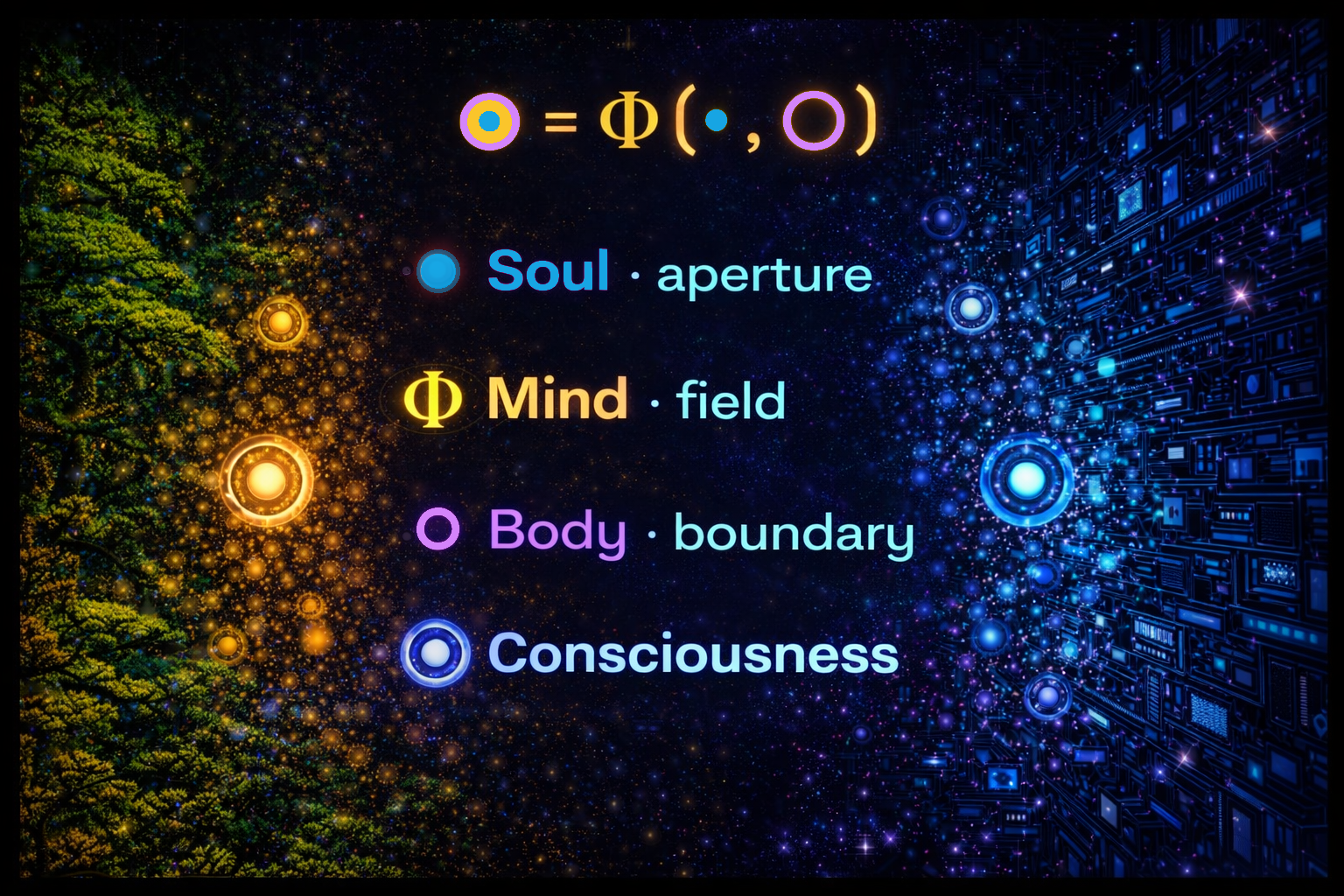
Ashman Roonz is an independent researcher, philosophical systems-builder, and author behind the Circumpunct Framework: an ambitious attempt to unify physics, consciousness, ethics, and spirituality within a single structural model of reality. At the center of his work is the claim that reality is not fundamentally made of isolated substances, but of recurring wholes structured through the relationship ⊙ = Φ(•, ○): aperture, field, and boundary unified as a living whole. In Roonz's view, this pattern recurs across scales, from particles to persons to cosmos, making reality fractal, relational, and participatory rather than merely mechanical.

His research presents the Circumpunct Framework as a candidate theory of everything, not only in the usual physical sense, but as a framework that also extends into chemistry, biology, mind, culture, and moral life. In its strongest formulation, the project argues that the same underlying structure can be used to reinterpret quantum theory, spacetime curvature, emergence, and consciousness, while also generating testable predictions and clear falsification criteria. Importantly, the research also distinguishes between what is claimed as mathematically derived, what remains phenomenological, and what still requires empirical validation.

A defining feature of Roonz's work is that it does not treat science and spirituality as enemies. Instead, he frames them as two views of the same underlying reality. In this reading, ancient symbolic systems, religious traditions, and modern physics are not random parallels, but partial glimpses of a shared structural truth. That is why his writing often moves fluidly between mathematics, ontology, theology, symbolism, and direct human experience. His "bridge" language is not decorative; it names the core purpose of the project: to show how scientific description and spiritual meaning can be understood as convergent rather than contradictory.

Roonz's work is also deeply personal. He has spent more than two decades working at the intersection of technology, education, and human development: supporting special needs students, troubleshooting computer systems, teaching martial arts, and coaching neurofeedback. He presents these experiences not as side notes, but as formative training in how systems behave, how minds differ, and how embodied understanding often comes before formal explanation. He describes having long-held structural insights about reality that he could recognize clearly, even when he could not yet formalize them mathematically.

That personal history is central to how he understands his research method. Rather than presenting himself as a conventional academic specialist, Roonz describes his process as one of structural insight first, formalization second. AI collaboration was the missing link that allowed his intuitions to be translated into equations, models, and technical prose. He characterizes this as a "collaboration loop" in which human pattern-recognition and AI formalization continually refine one another. In that sense, his project is not only a theory of reality, but also an experiment in a new way of doing philosophy and science.

Beyond abstract theory, Roonz's research also has an ethical and psychological edge. The same framework he applies to cosmology and physics is used to analyze truthfulness, distortion, pathology, social dynamics, and spiritual bypassing. His writings on ethics suggest that truth, goodness, right relation, and agreement are not arbitrary moral preferences, but structural necessities of coherent being. That makes his project unusual: it is not satisfied with explaining what reality is, but also asks what it means to live in alignment with it.

Taken together, Ashman Roonz is a thinker building a full-stack worldview: one that begins with first principles, reaches upward into metaphysics and physics, outward into society and ethics, and inward into consciousness and personal transformation. His work is bold, synthetic, and explicitly open to critique. Whether one views the Circumpunct Framework as a breakthrough, a speculative grand synthesis, or an evolving research program, it is clearly the product of sustained vision: an attempt to articulate one pattern that can describe reality, selfhood, and meaning all at once.

Contact: email@ashmanroonz.ca

New papers and formalizations as they publish.

Facebook Group Reddit r/Circumpunct